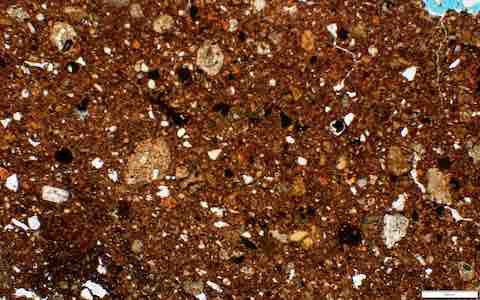
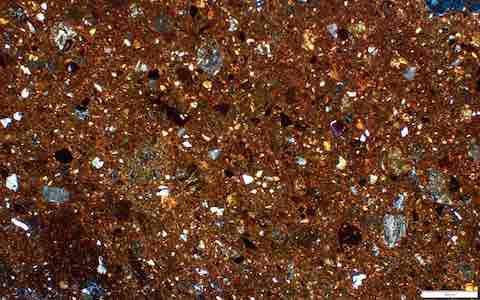
"Mangassi style"
| None (0) | Minor (1) | Few (2) | Common (3) | Frequent (4) | Major (5) | Very Dominant (6) |
| 0% | 0-5% | 5-15% | 15-30 % | 30-50% | 50-70% | 70-100% |
| Name | Cal. | Quartz | Feldspar | Pyroxene | Amphibole | Opaques | Olivine | Biotite | Muscovite | Epidote | Garnet/ Spinel | Ig./Met. Rocks | Sed. Rocks | Grog | Lithics/ Region |
|---|---|---|---|---|---|---|---|---|---|---|---|---|---|---|---|
| tpr256 | 0 | 0 | 5 | 3 | 1 | 2 | 0 | 0 | 0 | 0 | 0 | 5 | 0 | 0 | microlitic, vitric |
| Banks volcanic | 0 | 0 | 3 | 1 | 0 | 1 | 0 | 0 | 0 | 0 | 0 | 3 | 0 | 0 | Vanuatu |
| tpr258 | 0 | 0 | 1 | 3 | 0 | 1 | 0 | 0 | 0 | 0 | 0 | 6 | 0 | 0 | vitric, microlitic |
| Banks vitric | 0 | 0 | 1 | 2 | 0 | 1 | 0 | 0 | 0 | 0 | 0 | 6 | 0 | 0 | Vanuatu |
| Slide | Fabric | Possible Origin | Ware | Cal. | Quartz | Feldspar | Pyroxene | Amphibole | Opaques | Olivine | Biotite | Muscovite | Epidote | Garnet/ Spinel | Ig./Met. Rocks | Sed. Rocks | Grog | Lithics |
|---|---|---|---|---|---|---|---|---|---|---|---|---|---|---|---|---|---|---|
| WD_52_3 | tpr256 (Banks volcanic) | Banks | Post-Lapita Banks (2700 - 2000 BP) | 0 | 0 | 3 | 1 | 0 | 2 | 0 | 0 | 0 | 0 | 0 | 5 | 0 | 0 | vitric, microlitic |
| WD_52_1 | tpr258 (Banks vitric) | Banks | Post-Lapita Banks (2700 - 2000 BP) | 0 | 0 | 1 | 2 | 0 | 1 | 0 | 0 | 0 | 0 | 0 | 6 | 0 | 0 | vitric |
Poorly sorted, subangular to subrounded volcanic sand temper probably representing natural temper embedded in sandy clay bodies collected from slightly reworked colluvium or ravine fillings on inland flanks of island volcanoes, contains clinopyroxene and plagioclase feldspar typical of sands derived from bedrock volcanic assemblages of basalt and mafic andesite. Abundant polycrystalline lithic fragments of: (a)microlitic grains with plagioclase laths or microlites, and (b) vitrics.
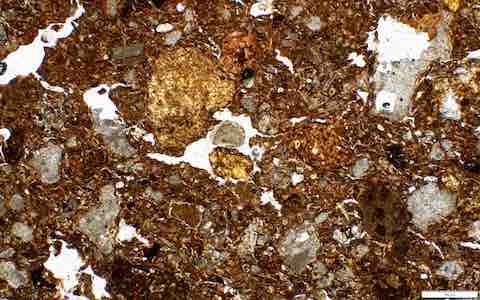
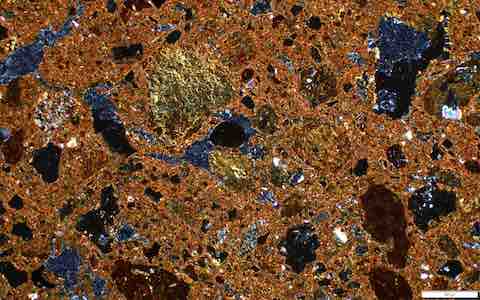
Colourless felsic glass.