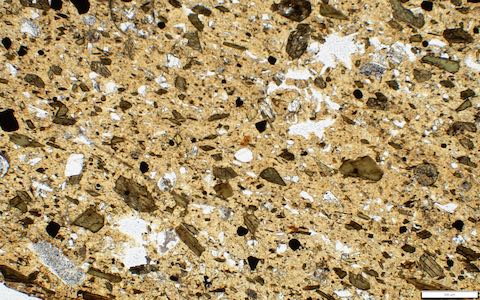
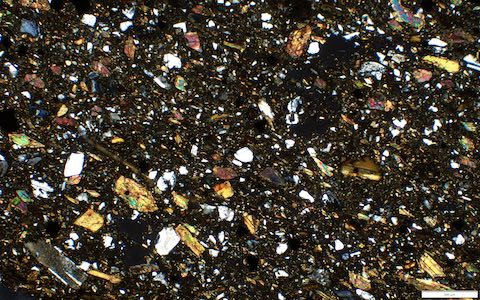
Timing unclear. Sherds originally classified as Lapita. 2 classes of rims. One class has internal rounded lips and plain decoration and may be from flat platters. The other class has notched everted rims and rectilinear incision decoration.
| None (0) | Minor (1) | Few (2) | Common (3) | Frequent (4) | Major (5) | Very Dominant (6) |
| 0% | 0-5% | 5-15% | 15-30 % | 30-50% | 50-70% | 70-100% |
| Name | Cal. | Quartz | Feldspar | Pyroxene | Amphibole | Opaques | Olivine | Biotite | Muscovite | Epidote | Garnet/ Spinel | Ig./Met. Rocks | Sed. Rocks | Grog | Lithics/ Region |
|---|---|---|---|---|---|---|---|---|---|---|---|---|---|---|---|
| tpr482 | 0 | 2 | 4 | 1 | 5 | 3 | 0 | 0 | 0 | 0 | 1 | 3 | 0 | 0 | microphaneritic |
| Exotic Tuam amphibolic | 0 | 0 | 4 | 0 | 2 | 2 | 0 | 0 | 0 | 0 | 0 | 1 | 0 | 0 | PNG |
| Slide | Fabric | Possible Origin | Ware | Cal. | Quartz | Feldspar | Pyroxene | Amphibole | Opaques | Olivine | Biotite | Muscovite | Epidote | Garnet/ Spinel | Ig./Met. Rocks | Sed. Rocks | Grog | Lithics |
|---|---|---|---|---|---|---|---|---|---|---|---|---|---|---|---|---|---|---|
| IL_2_4 | tpr482 (Exotic Tuam amphibolic) | ? | Type Y (1700 - 500 BP) | 0 | 0 | 4 | 0 | 5 | 2 | 0 | 0 | 0 | 0 | 0 | 3 | 0 | 0 | microphaneritic |
| IL_2_3 | tpr482 (Exotic Tuam amphibolic) | ? | Type Y (1700 - 500 BP) | 0 | 2 | 4 | 1 | 2 | 3 | 0 | 0 | 0 | 0 | 1 | 2 | 0 | 0 | microphaneritic |
Type Y style. Contains high levels of amphibole. The amphibole is green to brown and the blades and prisms range from 0.1 to 0.5 mm in length. The angular amphibole grains make up about 10% of the sherd. Plagioclase (<10%) occurs as large rectangular crystals which show growth rings. Some of the grains are partly sericitized. Other plagioclase crystals are small and angular. Magnetite (<1%) .
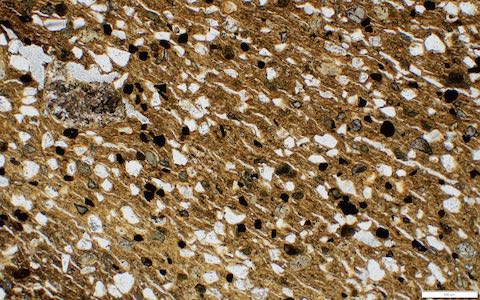
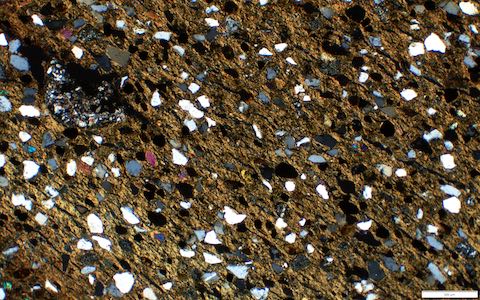
Type Y style. This sherd contains quartz, feldspar, amphibole, pyroxene, magnetite, spinel, rock fragments, ferruginized clay clasts and relict shells. The quartz and feldspar grains (10%) are generally angular and 0.2 mm in length. Amphibole blades (<5%) are green to brown, and less than 0.2 mm across. Magnetite (5%) occurs as rounded grains. Pale green pyroxene crystals are rare. Spinel is an accessory mineral occurring as angular grains up to 0.2 mm.