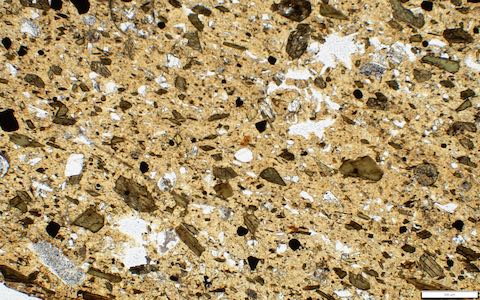
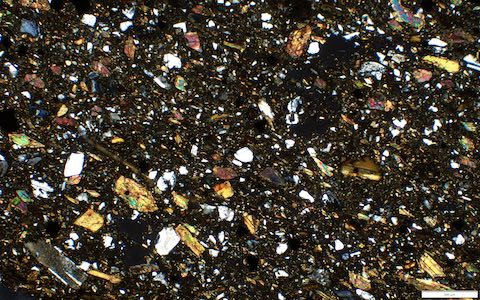
Slide: IL_2_4

Type Y style. Contains high levels of amphibole. The amphibole is green to brown and the blades and prisms range from 0.1 to 0.5 mm in length. The angular amphibole grains make up about 10% of the sherd. Plagioclase (<10%) occurs as large rectangular crystals which show growth rings. Some of the grains are partly sericitized. Other plagioclase crystals are small and angular. Magnetite (<1%) .

Mineral and Rock Abundances

Fabric: tpr482 - Exotic Tuam amphibolic

None (0) Minor (1) Few (2) Common (3) Frequent (4) Major (5) Very Dominant (6)
0% 0-5% 5-15% 15-30 % 30-50% 50-70% 70-100%
Cal. QuartzFeldspar Pyroxene Amphibole Opaques OlivineBiotite Muscovite Epidote Garnet/ Spinel Ig./Met. Rocks Sed. Rocks Grog Lithics
0 0 4 0 5 2 0 0 0 0 0 3 0 0 microphaneritic

Images

Tuam7_2 Tuam7_2
Sherd 7/2 from Tuam (Tuam). Slide IL_2_4 from I Lilley. x4 Magnification PPL (left) XPL (right). Scale bar: 0.5mm. High resolution image (user: Guest pwd: Guest) or full slide in VIMIPO. Imaged by K. Hardy and M. Leclerc, ANU.

Sherd: 7/2

None

Period: None wikidata:

Site: Tuam (Tuam)

Suspected origin site: ?

References:

Prehistoric exchange in the Vitiaz Strait, Papua New Guinea (Lilley, I.)